
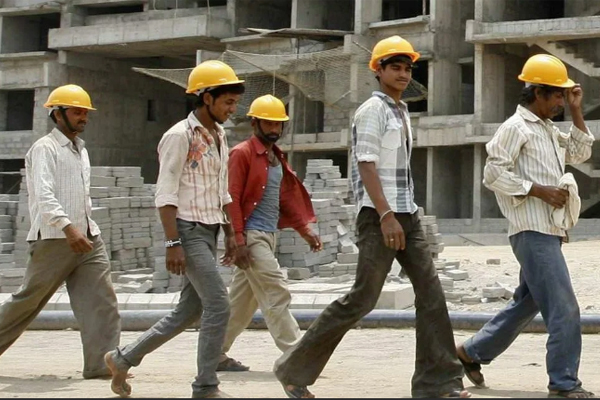
New Labor Codes: In a major overhaul of labor norms, the government on Friday, November 21, merged 29 laws into four labor codes aimed at simplifying business while protecting workers’ rights. These include the Code on Wages, the Industrial Relations Code, the Social Security Code, and the Occupational Safety Code.
The new labor codes introduce several specific provisions that are likely to impact over 400 million workers in both the formal and informal sectors.
With provisions such as equality for women in the workplace, gratuity after one year for fixed-term employees, free annual health check-ups, double pay for overtime, and more, here are the highlights of the newly launched labor code:
Code 1: The Code of Wages, 2019
Code 1, or the Code on Wages, 2019, aims to simplify and unify four laws: the Payment of Wages Act, 1936; the Minimum Wages Act, 1948; the Payment of Bonus Act, 1965; and the Equal Remuneration Act, 1976. It aims to strengthen workers’ rights and promote uniformity in wage-related concerns.
Universal Minimum Wages: Minimum wages have become a legal right for all employees in the organized and unorganized sectors. Previously, the Minimum Wages Act covered only ~30% of workers in scheduled employment.
Floor Wages: The government will set a floor wage based on the minimum living standard. No state can set a minimum wage below this level.
Wage Criteria: Wages will be determined based on the minimum wage, taking into account the worker’s skill level, geographic area, and job conditions.
Gender Equality: Employers should not discriminate on the basis of gender, including transgender identity, in recruitment, wages, or employment conditions for similar work.
Universal Coverage: All employees, regardless of the wage limit, will receive timely payment, and unauthorized deductions will be prohibited.
Overtime Compensation: Employers must pay employees double the standard rate for any overtime worked.
Responsibility for Wage Payment: The employer must pay the employee; failing which, the entity will be liable for unpaid wages.
Compounding of Offences: First-time, non-imprisonable offenses can be compounded by imposing a penalty, but not for repeated offenses within five years.
Decriminalization of Offences: For some first-time offenses, imprisonment will be replaced by a fine of up to 50% of the maximum fine.
Code 2: Industrial Relations Code, 2020
The Industrial Relations Code (IR Code) has been developed by consolidating the relevant provisions of the Trade Unions Act, 1926, the Industrial Employment (Standing Orders) Act, 1946, and the Industrial Disputes Act, 1947.
The Code aims to simplify laws relating to trade unions, employment conditions, and the investigation and resolution of industrial disputes.
Fixed Term Employment: The Code allows for time-bound contracts with equal pay and benefits, with eligibility for gratuity after one year.
Re-skilling Fund: A fund has been created to train workers laid off from an industrial site, with an amount equivalent to 15 days’ salary for each laid-off worker. Trade Union Recognition: A union with 51% membership is recognized as a negotiating union; otherwise, a negotiating council is formed from unions with at least 20% membership.
New Definition of Workers: The new definition of worker includes sales promotion staff, journalists, and supervisory employees earning up to ₹18,000/month.
Extended Definition of Industry: An industry includes all systematic employer-employee activities, regardless of profit or capital.
Higher layoff limit: The approval limit has been increased from 100 to 300 workers; states can further increase this limit.
Equal representation: Proportional representation of women in grievance committees for gender-sensitive redressal.
Work-from-home provision: Remote work is permitted in the service sector by mutual consent.
Industrial tribunal: Two-member tribunals, consisting of one judicial and one administrative member, are established to resolve disputes quickly.
Strike notice: To promote dialogue and reduce friction, 14 days’ notice is required at all locations.
Strike definition: This includes “mass casual leave” to prevent sudden strikes.
Criminalization: Minor offenses can now be settled with monetary penalties.
Code 3: Code on Social Security, 2020
The Code on Social Security consolidates the existing nine social security acts, covering all workers—including unorganized, gig, and platform workers—including life, health, maternity, and provident fund benefits.
Extended ESIC (Employee State Insurance) coverage: ESIC now applies throughout India, eliminating the “notified area” criteria.
EPF (Employee Provident Fund) inquiry limit: A five-year limit has been set for initiating EPF inquiry and recovery proceedings, which must be completed within two years, extendable by one year.
Reduced EPF appeal deposit: Employers appealing against EPFO orders will now have to deposit only 25% of the assessed amount, down from 40-70% previously.
Inclusion of gig and platform workers: Aggregators, gig workers, and platform workers will be included in social security coverage. Social Security Fund: A fund is proposed to finance schemes for unorganized, gig, and platform workers, including life, disability, health, and old-age benefits.
Definition of Wages: This includes basic pay, dearness allowance, and retaining allowance.
Definition of Dependents: Coverage has been extended to grandparents, and in the case of female employees, it also includes dependent parents-in-law.
Accident Coverage: Accidents occurring while traveling between home and workplace are now considered employment-related and qualify for compensation.
Early Gratuity for Fixed-Term Employees: Fixed-term employees become eligible for gratuity after one year of continuous service.
Code 4: Occupational Safety, Health and Working Conditions Code 2020
This Code has been formulated by consolidating and simplifying the relevant provisions of 13 Central Labour Acts. It aims to strike a balance between the dual objectives of protecting workers’ rights and ensuring safe working conditions, while also promoting a business-friendly regulatory environment.
Employment for women: Women can work in all workplaces and at night (before 6 a.m. and after 7 p.m.) with consent and safety measures.
Healthcare: Free annual health check-up for employees.
Working hours and overtime: Normal working hours are 8 hours/day and 48 hours/week. Overtime requires worker consent and is paid at double the time.
Expanded definition of migrant worker: The definition of inter-state migrant worker now includes workers who work directly, through contractors, or who migrate on their own.
National Database for Unorganized Workers: A national database will be created for unorganized workers, including migrants, to help them find jobs and other benefits.
Appointment Letter: To increase transparency and accountability, workers will be provided with an appointment letter detailing job details, salary, and social security.
Victim Compensation: In case of injury or death, the court may direct that at least 50% of the fine be paid to the victims or their heirs.
Safety Committee: Places with 500 or more workers will establish a safety committee consisting of employer and worker representatives.
(With agency input)