
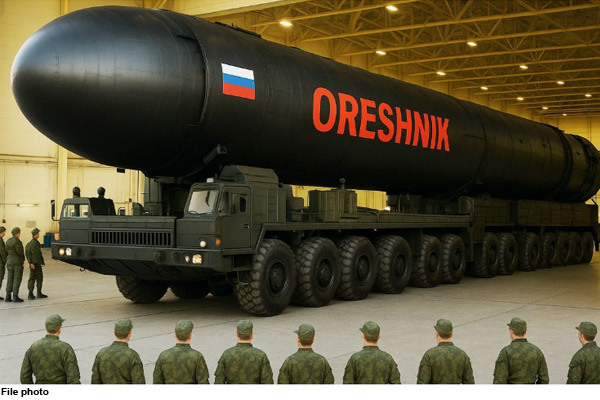
Russia has used its advanced hypersonic Oreshnik (meaning “hazel tree”) intermediate-range ballistic missile in a strike against Ukraine, marking only the second confirmed operational use of this weapon.
This latest launch occurred during a massive overnight attack on January 9, 2026 (early morning hours), as part of a barrage involving 36 missiles (including the Oreshnik) and 242 drones targeting energy infrastructure, drone production facilities, and other critical sites across Ukraine.
Key Details of the Strike
Target Location — The Oreshnik reportedly struck near the western city of Lviv (about 60 km from the Polish/EU/NATO border), likely hitting an underground gas storage facility (such as the Bilche-Volytsko-Uherske site, one of Europe’s largest). Russian sources claim it targeted infrastructure linked to drone production and energy supporting Ukraine’s military-industrial complex.
Reported Justification — Russia’s Defense Ministry described it as retaliation for an alleged Ukrainian drone attack on one of President Vladimir Putin’s residences in late December 2025. Ukraine, the United States (including President Donald Trump), and Western officials have dismissed this claim as false or “absurd,” with some calling it a pretext to escalate amid ongoing peace talks.
Russia fires Oreshnik hypersonic missile at Lviv, first confirmed strike in western Ukraine
Mayor confirms 6 explosions targeting infrastructure near Poland 🅱️order
Hypersonic IRBM traveled 1,500km in 7 minutes at Mach 10
No air defense can intercept this weapon system pic.twitter.com/wZE2X8YFYz
— Boi Agent One (@boiagentone) January 8, 2026
Impact — The broader attack killed at least 4 people (mainly in Kyiv) and wounded dozens, left half of Kyiv’s apartment blocks without heating amid freezing temperatures (-8°C), and caused damage to residential buildings and infrastructure. The Oreshnik strike itself appears to have caused limited explosive damage (possibly using inert/dummy warheads again, similar to the first use), but its kinetic impact and location near NATO borders have raised alarms.
Ukrainian Response — Ukraine’s Air Force confirmed the missile’s launch from Russia’s Kapustin Yar test range near the Caspian Sea. It traveled at speeds of around 13,000 km/h (roughly Mach 10+). Kyiv called the use near the EU/NATO border a “grave threat” to European security, labeling it a potential war crime, and urged an emergency UN Security Council meeting, tougher sanctions on Russian oil, and increased allied support.
About the Oreshnik Missile
The Oreshnik is a nuclear-capable intermediate-range ballistic missile (IRBM) that Putin has promoted as “unstoppable” due to its hypersonic speed (over Mach 10), ability to carry multiple independently targetable reentry vehicles (MIRVs) with submunitions, and flight path through the upper atmosphere, which evades most current Ukrainian air defenses.
First Use — November 21, 2024, against a military facility in Dnipro (also with dummy warheads, causing minimal damage — widely seen as a demonstration/test).
Capabilities — Range up to ~5,500 km, can use conventional, nuclear, or inert payloads. Experts note it’s derived from older designs (like the RS-26 Rubezh) with limited new technology, remaining somewhat experimental.
This strike appears partly symbolic — a show of force amid stalled peace negotiations, recent U.S. actions (e.g., seizing a Russian oil tanker), and discussions on postwar security guarantees for Ukraine. Western leaders, including EU officials, have condemned it as escalation and intimidation, while Ukraine sees it as a test of transatlantic resolve.
The situation remains tense, with risks of further escalation. Stay updated via reliable sources as more details emerge.
(With agency input)