
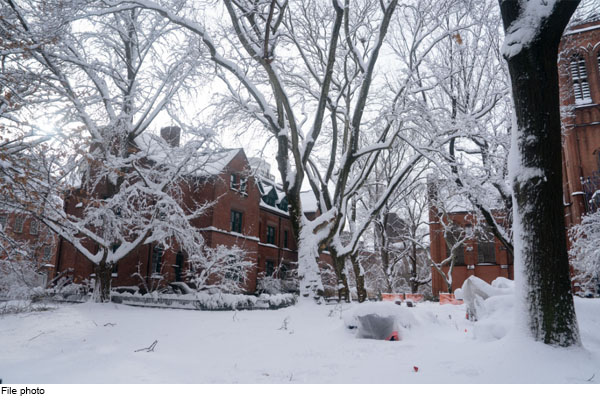
Winter Storm Hernando: A massive blizzard, Hernando, struck the East Coast of the United States on Monday, bringing record-breaking snowfall. People were stranded wherever they were, and power was also cut off across the region, disrupting normal life for millions.
A BBC report, quoting the National Weather Service, said that parts of Rhode Island and Massachusetts received approximately 37 inches of snow, with New York City’s Central Park receiving over 19 inches.
Weather warnings were issued from North Carolina to Northern Maine and parts of eastern Canada. The report also stated that more than 600,000 properties on the US East Coast lost power. Due to the winter storm, the Boston Globe, a major US newspaper, said it would not print, marking the first time in its 153-year history.
*** EVERYONE IS STUCK ON ROUTE 3! ***
*** 3-5 foot snow drifts!! ***
You know it’s a serious blizzard when even bobcats, plows, and tow trucks are getting stuck on the ramp 😳❄️ Route 3 outside Plymouth, MA, is a mess as Winter Storm Hernando unleashes intense Nor’easter… pic.twitter.com/v8ouVdmTK1— Chicago & Midwest Storm Chasers (@ChicagoMWeather) February 23, 2026
Important Update on Hurricane Hernando
Reports indicate that travel across the region has been severely impacted, with some states and cities imposing travel bans during the worst of the storm. According to a Bloomberg report, more than 11,000 flights had been grounded as of Tuesday (local time). The impact is expected to last for several days.
In Massachusetts, drivers were advised to stay off the roads in some parts as snowplow crews struggled to complete their work following blizzards along the state’s South Coast. Massachusetts Governor Maura Healey said, “We’ve had reports of abandoned and stranded cars on the roads, and tow trucks are having difficulty reaching them,” and urged drivers to stay put “for the safety of drivers clearing snow and emergency officials trying to do their jobs.” A whiteout occurs when snowfall significantly reduces visibility.
About 20 inches of snow fell in Manhattan’s Central Park from February 22nd to Monday (local time). According to the National Weather Service, more than 22 inches of snow fell in Islip, Long Island. National Weather Service meteorologist Jim Connolly said that by Monday afternoon, the snow had decreased across New York and conditions were improving. He said the worst was over for New York. Soon after, New York City Mayor Zohran Mamdani lifted the order that had closed roads, highways, and bridges to most traffic. City schools are expected to reopen for in-person learning on Tuesday (local time).
Heavy snowfall damaged power lines and caused outages from Virginia to Massachusetts. According to data from PowerOutage.com, more than 500,000 homes and businesses were without power as of 5:45 PM local time. Massachusetts reported the most outages, with 282,024, followed by New Jersey with 93,090.
Reports quoted Frank Pereira, senior branch forecaster at the US Weather Prediction Center, as saying that a weak system moving through the Mid-Atlantic from Thursday to Friday could bring a few inches of fresh snow to New York City, even as far north as Boston. Pereira also predicted a more severe storm could arrive mid-next week; however, the forecaster said it was too early to predict details.
Citing the National Weather Service, the BBC reported that the so-called “nor’easter” is expected to move away from the US and across coastal parts of eastern Canada on Tuesday, although strong winds are expected to persist.
According to a report by Weather.com, the worst snowfall from Winter Storm Hernando has subsided, but strong winds are expected to continue in the Northeast overnight, potentially leading to whiteout conditions as the snow reduces visibility. Blizzard warnings are set to expire this evening for several coastal areas, including major cities like New York and Portland, Maine, as the snowfall subsides. However, in more exposed areas like Boston, blizzard-like conditions may persist until Tuesday morning due to persistent strong winds. Officials are urging people to avoid unnecessary travel. Those who must venture out are advised to take extra time and proceed with caution.
(With inputs from agency)