
On December 10, Australia became the first country to ban social media for children under the age of 16. The move was welcomed by many parents and children’s advocates, but criticized by major technology companies and free-speech advocates.
From midnight, the ten largest platforms, including TikTok, Alphabet’s YouTube, Meta’s Instagram, and Facebook, were ordered to block children or face fines of up to A$49.5 million ($33 million) under the new law, which is being closely monitored by regulators worldwide.
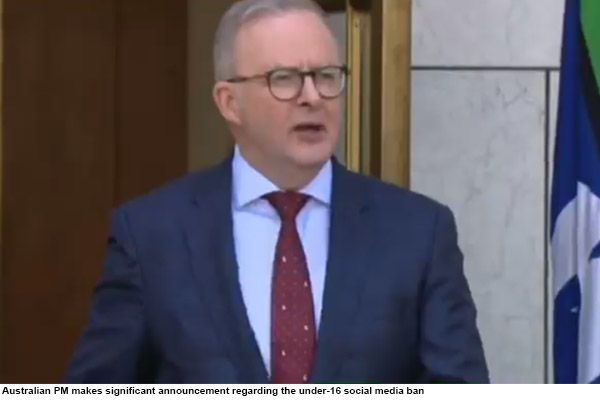
Australian Prime Minister Anthony Albanese has said that the country’s historic ban on social media for children under the age of 16 has now come into effect in Australia, making it the first country in the world to “try it out.”
Albanese highlighted the challenges faced by both parents and children due to the influence of social media, saying this is a step towards parents and children finding peace of mind so they can experience childhood.
Albanese tells the press that he wants people to engage and talk to each other like he did at the start of his political career. What exactly does he think it is that people do on social media?!
He then goes on to reveal the real reason for the current attack on social media… pic.twitter.com/6oRGuj1nnT
— Miss Madeleine (@MadsMelbourne) November 14, 2024
According to news agency ANI, Albanese said in a broadcast message, “Across Australia, people under the age of 16 are starting their day a little differently—without social media. This is a big change, and we’re the first country in the world to try it. But it really matters.”
“Algorithms, never-ending feeds, and pressures like no generation has had to deal with before. Today’s change is about helping you keep your children safe online. Putting the responsibility where it belongs—on the social media giants, not on the parents,” he said.
The Prime Minister said that by banning social media for those under 16, we are giving children a childhood and parents more peace of mind.
In another video message, the Australian Prime Minister said this was the day Australian families were taking power back from these big tech companies, asserting children’s right to be children and parents’ right to peace of mind.
He said in the video, “This is leading the world. This is Australia showing that enough is enough. This is about taking control back for our families.”
According to UNICEF Australia, from December 10, “anyone under 16 in Australia will not be able to have or create accounts on TikTok, Instagram, YouTube, Snapchat, X (formerly Twitter), Facebook and other social media apps.”
What does the law say in Australia?
Australia has introduced a new law aimed at protecting young people from the harmful effects of social media. Under this law, anyone under the age of 16 will be barred from using social media platforms; these rules will come into effect on December 10th.
This law requires a minimum age of 16 to have an account on some social media platforms, and parents cannot authorize children under 16 to use these platforms.
While this law does not punish young people or their families, it places the responsibility on social media companies to prevent children under 16 from creating accounts or risk heavy fines (up to approximately $50 million).
This decision comes after the Australian government passed the Online Safety Amendment (Social Media Minimum Age) Bill 2024 on November 28th of last year.
Major platforms like Facebook, Instagram, Snapchat, and TikTok, along with streaming services like Kickstarter and Twitch, are covered by this ban. However, some popular apps—including Roblox, Pinterest, and WhatsApp—are currently excluded from these restrictions.
Citing the government, UNICEF Australia emphasized that the social media ban is necessary to protect the mental health and well-being of Australian children and teens from the risks of social media, such as cyberbullying, harmful content, and online predators, which outweigh its benefits.
It’s about helping you keep your children safe online.
UNICEF Australia further stated that applications like Messenger Kids, WhatsApp, Kids Helpline, Google Classroom, and YouTube Kids are not expected to be part of the ban.
Albanese’s center-left government proposed this landmark legislation, citing research showing the mental health harms of excessive social media use among young teenagers, including misinformation, bullying, and harmful portrayals of body image.
Several countries, from Denmark to New Zealand and Malaysia, have indicated they may study or emulate Australia’s model, making the country a test case for how far governments can push age-gating without stifling speech or innovation.
(With agency input)