
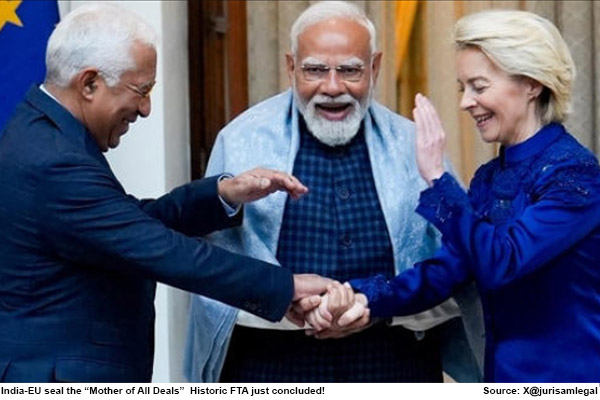
India-EU Trade Deal: Amidst tariff tensions, India is set to finalize its biggest deal with the European Union, and an announcement is expected tomorrow, January 27th. Let’s understand how India stands to benefit from the India-European Union Free Trade Agreement (FTA) based on the latest developments.
Historical Scale and Coverage
This deal connects approximately 2 billion people (India + 27 EU countries) and a combined economy of nearly $27 trillion, making it one of the world’s largest FTAs and often referred to by both sides as the “mother of all deals.”
Elimination of Tariffs on Over 90% of Goods
Tariffs will be eliminated or significantly reduced on over 90% of traded goods, covering a wide range of products and boosting bilateral trade (currently ~$136-137 billion in goods, projected to exceed $200-250 billion in the next decade).
ALSO READ: ‘Mother of All Deals’ signals a major shift in India’s global economic landscape
Key Benefits for Indian Exports
Lower or zero duties on key Indian exports such as textiles, garments, footwear, pharmaceuticals, steel, jewelry, petroleum products, machinery, and chemicals — helping to restore competitiveness lost due to the EU’s withdrawal of GSP (Generalized System of Preferences) benefits on several products from 2023/2026.
Access for EU Products in India
India will gradually reduce high tariffs on EU imports, particularly lowering import duties on cars from 110% to around 40% (especially for high-value vehicles >€15,000), benefiting brands like BMW, Volkswagen, and Renault, as well as providing easier access for wines, spirits, machinery, and electrical goods.
Focus on Goods, Services, and Trade Rules
The main FTA covers goods, services, investment facilitation, digital trade, and regulatory alignment. Separate negotiations are underway for investment protection and geographical indications (GIs), narrowing the scope of the main agreement to expedite its completion.
ALSO READ: 10 Key Aspects of the India-EU FTA
Strategic Timing Amidst Global Trade Shifts
Driven by rising protectionism (e.g., the US’s high tariffs under current policies), this deal helps India diversify exports away from the US market and compensates for losses from suspended EU GSP preferences (which affected ~87% of eligible Indian exports).
Sectoral Boost and Job Creation
Expected gains in labor-intensive sectors like textiles and garments (the EU imports $125 billion annually; India currently has a 5-6% share), pharmaceuticals, automotive, electronics, and clean energy – potentially creating millions of jobs and boosting industrial competitiveness.
Safeguards for Sensitive Sectors
India has protected sensitive sectors like agriculture and dairy from deep liberalization to safeguard farmers and local industries. Non-tariff barriers, restrictions on services, and EU climate measures (e.g., CBAM – Carbon Border Adjustment Mechanism) remain areas of concern that could partially offset the benefits.
India’s FTA Momentum
This will be India’s 9th major FTA in the last 4 years (following deals with the UK, Oman, New Zealand, Australia, UAE, EFTA, etc.), reflecting New Delhi’s aggressive push for market access in a protectionist global environment.
10 Key Aspects of the India-EU Free Trade Agreement
The Largest Agreement Yet
It is being called the ‘Mother of All Deals’ as it will be the most comprehensive trade agreement between India and the EU.
Accelerated Bilateral Trade
The agreement is expected to significantly boost India-EU trade. Tariff Reductions
Lower import-export duties will make Indian goods cheaper and more competitive in Europe.
Benefits for Indian Industries
Significant gains for IT, pharmaceuticals, textiles, automobiles, chemicals, and green energy sectors.
Opportunities for MSMEs and Startups
Small and medium-sized enterprises will gain easier access to the European market.
Increased Foreign Direct Investment (FDI)
European companies will increase investment in India, creating employment opportunities.
Strengthened Supply Chains
Reduced dependence on China and the development of alternative global supply chains.
Emphasis on Green and Sustainable Trade
Promotion of trade while considering climate change and environmental standards.
Clear Rules on Data and IPR
Agreement on data protection, intellectual property rights (IPR), and digital trade.
Strengthened India’s Global Position
This agreement will further strengthen India’s position on the global economic stage.
Next Steps and Timeline
Announcement on January 27 → Finalization of the text → Ratification by the EU Parliament and member states (this may take 1+ year) → Implementation (not immediate). This will also be linked to parallel agreements on security/defense cooperation and mobility of skilled workers.