
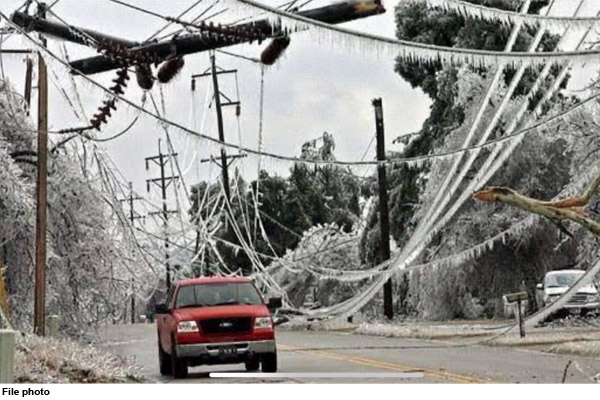
US Blizzard Alert: Millions of Americans from New Mexico to the Carolinas are bracing for a potentially devastating blizzard that could bring down trees, snap power lines, and leave communities without electricity for days.
Meanwhile, according to the Associated Press, meteorologists have warned that cities such as Washington, D.C., Philadelphia, New York City, and Boston could see snowfall so heavy that travel will become extremely dangerous or nearly impossible.
According to a Reuters report, Brian Hurley, a meteorologist at the National Weather Service (NWS) Weather Prediction Center in College Park, Maryland, said that 4 to 10 inches (10 to 25 cm) of heavy, wet snow is expected to fall starting Saturday, with temperatures in Washington, D.C., dropping to 20 degrees Fahrenheit (minus 5.5 C). Meanwhile, the overnight low in Boston is expected to be around 7 degrees Fahrenheit (minus 14 C).
The NWS said Thursday afternoon that approximately 160 million people, or about half the U.S. population, were under various winter storm watches, warnings, and advisories. These alerts spanned a vast area, stretching from Arizona and Montana in the west to the Carolinas and Maine in the east.
The storm is expected to begin Friday and continue through the weekend, bringing a widespread mix of winter weather, including heavy snow, freezing rain, and sleet. Meteorologists say an atmospheric river of moisture could develop by the weekend, spreading rain across Texas and other Gulf Coast states, then moving northeast through Georgia and the Carolinas.
Weather forecasters with the National Weather Service on the East Coast, who are highly confident the storm will hit major cities, said, “Snowfall amounts could reach a foot or more in major cities along I-95 from D.C. to Boston.” Forecasters at the NWS office serving Washington and Baltimore warned that the region could face significant hazards as heavy snow and ice, combined with prolonged, bitter cold temperatures, could create major threats to life and property across much of the area.
As the storm approached, Reuters reported that a “Code Blue” was expected to remain in effect in New York state, a measure that requires social service agencies to extend shelter hours and ensure that homeless residents have access to safe, warm places. Chicago was bracing for frigid temperatures, with highs expected to be only 2 degrees Fahrenheit below zero on Friday and Saturday, and wind chills dangerously low, reaching as low as 30 degrees below zero (minus 34 C).
Meanwhile, in Texas, Governor Greg Abbott declared a state of emergency, deploying additional personnel and equipment to assist with traffic management, monitor power outages, and rescue those affected by the storm. He also encouraged residents to remain vigilant and take precautions, urging Texans to “stay weather aware, check DriveTexas.org before traveling, and heed the instructions of state and local officials.”
Forecasters said the system would move out of most areas by late Sunday or early Monday, but the bitter cold would linger. Arctic air pushing south from Canada could keep temperatures well below freezing, with Fargo, North Dakota, expecting a high of only 5 degrees below zero on Saturday.
(With agency input)