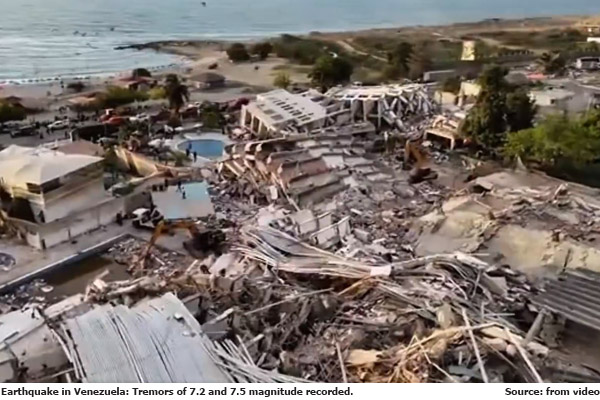
Venezuela Earthquake: In earthquake-hit Venezuela, locals are engaged in rescue operations using shovels, ropes, and their bare hands. They are attempting to fill the gap left by the government’s slow and inadequate response following the country’s most powerful earthquake in a century.
Volunteers say they have stepped in where official rescue efforts fell short.
‘The government is nowhere to be seen’
Among the volunteers is Alexander Delgado, a physical education teacher from Venezuela’s central Aragua state. According to a Reuters report, he arrived in the coastal state of La Guaira—which was severely affected—a day after the twin earthquakes struck.
Despite having no formal training in rescue operations, Delgado has been coordinating a civilian rescue team for several days. The team is conducting search operations at the collapsed Hugo Chávez public housing complex.
Delgado said, “You see firefighters and [the Mexican rescue team] ‘Los Topos,’ but the government is nowhere to be seen.”
According to reports, his team has been meticulously clearing debris for days and listening for signs of life beneath the rubble. Locals are assisting them by providing water, masks, and ice, as well as information about the housing complex.
According to news outlets, even on the sixth day of the disaster—and despite the arrival of international rescue teams and local firefighters—rescue crews lacked the necessary heavy equipment.
Later, volunteers recovered the body of a woman trapped in the concrete rubble and paused operations while waiting for forensic officials to remove the body. Volunteers say they are ‘making do’
Many volunteers say they have become accustomed to working with limited government assistance.
Veterinarian Mijad Diaz, who is involved in rescue efforts alongside university volunteers, said that authorities should have played a much larger role.
“I want a greater presence from government agencies, because ultimately, they are the ones responsible for this,” Diaz said. “But in the end, we have become used to operating with almost no resources.”
Frustration over restrictions on aid
While the government initially welcomed civilian volunteers, it later restricted movement into La Guaira. This has sparked resentment among those trying to assist with rescue operations.
Some volunteers and eyewitnesses have also alleged that military and police personnel obstructed aid delivery, confiscated donated goods, and looted valuables from damaged buildings.
A government employee stationed at a checkpoint told Reuters that police officers and soldiers allegedly seized aid supplies from trucks and boasted about what they had managed to “snatch.”
Government dismisses criticism
Senior Venezuelan officials have rejected allegations of a slow response and misconduct, stating that such criticisms stem from disinformation campaigns on social media.
The Interior Ministry announced that four police officers present at the scene have been detained and removed from duty; they are accused of misappropriating valuables found at the disaster site.
The Ministry maintained that the police generally operated transparently during the rescue operations.
NGOs return despite restrictions
The disaster has led to the return of several Venezuelan civil society groups whose activities had previously been banned by the government. Roberto Patiño, founder of the NGO ‘Alimenta La Solidaridad’, stated that the organization has resumed delivering food, medicines, rescue equipment, and Starlink internet terminals to affected communities.
“We are working and trying to show, once again, that our mission is to support communities—not something for which we should be harassed,” Patiño said.
Families appeal for accelerated rescue efforts
For many families, the rescue operation has become a deeply personal matter. Volunteer Miguel Poleo Delgado joined a rescue team; he was searching for his stepdaughter, her husband, and their son, whom he believes are buried beneath the rubble.
He said residents had repeatedly informed authorities that survivors remained alive under the collapsed buildings.
“We told them two days ago that there were survivors—that they were knocking—but nothing happened,” Poleo said. “They aren’t helping anyone.”
Death toll nears 2,000
A week-long period of national mourning began in Venezuela on Wednesday. The death toll from two earthquakes that struck last week has reached approximately 2,000, and hopes of finding survivors are fading. Meanwhile, humanitarian concerns are shifting toward food shortages, the spread of disease, and prolonged displacement.
Interim President Delcy Rodríguez announced the seven-day national mourning period, stating that the country is grieving the massive loss of life caused by the disaster.
“The soul of Venezuela is shattered by the loss of life caused by the terrible earthquakes,” Rodríguez wrote on Telegram.
Thousands still missing
The United Nations estimates that approximately 50,000 people are missing, while the opposition claims the number of missing persons exceeds 40,000.
(With agency inputs)