
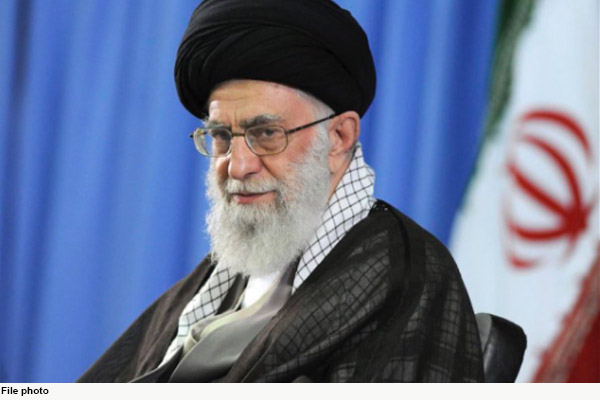
Ali Khamenei’s funeral: Thousands gathered in Tehran on Sunday for the second day of funeral proceedings for Iran’s former Supreme Leader, Ali Khamenei. While three of his sons appeared in public, his successor, Mojtaba Khamenei, did not make an appearance.
The events taking place at Tehran’s Grand Mosalla religious complex are among the largest public gatherings in Iran since Khamenei and four family members were killed in Israeli airstrikes on February 28—strikes launched based on US intelligence.
Three sons attended; Mojtaba absent
Ali Khamenei’s eldest son, Mostafa, and his younger sons, Masoud and Meysam—all of whom are clerics—attended the funeral prayers on Sunday.
However, there was no sign of Mojtaba Khamenei. Although he was named Iran’s new Supreme Leader shortly after his father’s death, he has not yet appeared in public.
Iranian officials state that Mojtaba was wounded in the Israeli strikes, though the severity of his injuries remains unclear. So far, he has communicated only through written statements.
His absence is expected to remain a topic of discussion, as the funeral proceedings are scheduled to continue throughout the week, culminating in Khamenei’s burial in Mashhad on Thursday.
Funeral procession to continue
The funeral procession will continue in Tehran on Monday, moving to the religious city of Qom on Tuesday and to Iraq on Wednesday. On Thursday, Khamenei will be laid to rest in his hometown of Mashhad in northeastern Iran.
Before Khamenei’s body was moved from the Grand Mosalla complex, the 97-year-old senior cleric Grand Ayatollah Jafar Sobhani led the funeral prayers.
Iran Demonstrates Resolve
Beyond the mourning for Khamenei—who led the Islamic Republic for over three decades—the funeral proceedings have also become a platform for Iranian officials to demonstrate their resolve following a five-week conflict with Israel and the United States.
Parliament Speaker Mohammad Bagher Ghalibaf, a key official involved in negotiations with the US, stated on ‘X’ that “the proud and invincible people of Islamic Iran” had united to pay tribute to their “martyr.”
Officials anticipate that over 10 million people will attend the funeral events in Tehran. A public holiday was declared for Sunday to facilitate public participation, while extensive security measures and medical facilities were deployed amidst concerns regarding crowd safety.
Senior Military Leaders Re-emerge
After remaining out of the public eye during the recent confrontation, Ahmad Vahidi, the new commander of Iran’s Revolutionary Guards, attended the funeral for the second consecutive day.
Esmail Qaani, commander of the Revolutionary Guards’ Quds Force—a leader rarely seen in public—also attended; he told Iranian state television that after a lifetime of “struggle,” Khamenei’s “auspicious end” was truly fitting.
Calls for Retaliation Dominate the Funeral
Despite the ceasefire currently in effect between Iran and the US, the funeral has also become a venue for public demands to avenge Khamenei’s death.
One mourner told AFP, “(Khamenei’s) killers must be punished.”
Another person present said, “We have come to show the world that we support our revolution and our leader, and we seek retribution for the blood of our loved ones.”
Both Tehran and Washington have warned that they are prepared to resume military action, notwithstanding the initial ceasefire agreement.
Regional allies paid tribute
According to Iranian state media, delegations from Hamas and Lebanon’s Hezbollah met with Iranian Foreign Minister Abbas Araghchi on Saturday.
Representatives from Yemen’s Houthi movement and Palestinian Islamic Jihad also attended the funeral ceremonies, highlighting Iran’s enduring ties with armed groups across the Middle East.
(With agency inputs)