
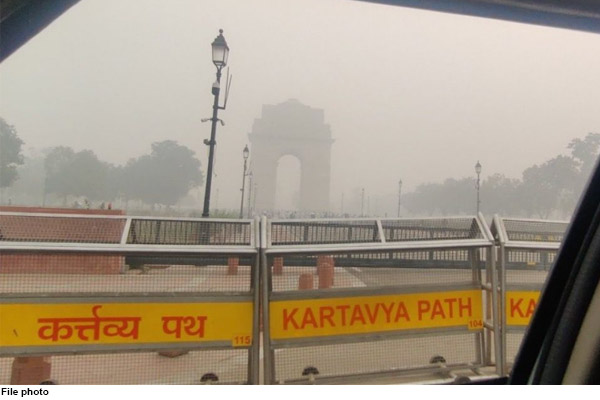
Air Pollution: Dharuhera in Haryana was the most polluting city in October, followed by Delhi, Ghaziabad, and Noida, according to a research published on Tuesday by the Center for Research on Energy and Clean Air (CREA).
For the past three days, the national capital’s air quality has stayed in the “very poor” range.
With an average concentration of 107 µg/m³ in October—three times higher than the September average of 36 µg/m³—the nation’s capital ranked as the sixth most polluted city in the nation.
Need for a Long-Term Action Plan
The CREA report states that despite stubble burning contributing less than 6 percent to Delhi’s PM2.5 levels in October, the rapid increase in pollution levels shows the impact of year-round emission sources.
It also emphasized the need for a long-term mitigation plan, beyond short-term seasonal measures such as the Graded Response Action Plan.
Dharuhera Exceeds NAAQS Limits
In October, on 77% of the days, Dharuhera, which recorded two ‘severe’ and nine ‘very poor’ days, exceeded the National Ambient Air Quality Standards (NAAQS) limits.
Top 10 Most Polluted Cities in October
Following Dharuhera, the next most polluted cities were Rohtak, Ghaziabad, Noida, Ballabhgarh, Delhi, Bhiwadi, Greater Noida, Hapur, and Gurugram.
Overall, four cities, each from Uttar Pradesh and Haryana, were included in the top 10 list, all located in the NCR.
Cleanest Cities in October
Shillong in Meghalaya was the cleanest city in India in October, with an average PM2.5 concentration of 10 µg/m³.
The report stated that four cities from Karnataka, three from Tamil Nadu, and one each from Meghalaya, Sikkim, and Chhattisgarh were among the top 10 cleanest cities in India. The report stated that PM2.5 levels were recorded below India’s NAAQS limit of 60 µg/m³ in 212 out of 249 cities. However, only six cities managed to meet the World Health Organization’s (WHO) daily safe guideline of 15 µg/m³.
Delhi’s AQI remains very poor
On Tuesday, Delhi’s Air Quality Index (AQI) was slightly better compared to Monday. However, pollution levels remained alarming in several parts of the city. Since Diwali, the AQI in many areas of the National Capital Region (NCR) has been in the ‘poor’ and ‘very poor’ categories.
AQI Levels
An AQI between 0 and 50 is considered ‘good’, 51-100 ‘satisfactory’, 101-200 ‘moderate’, 201-300 ‘poor’, 301-400 ‘very poor’, and 401-500 ‘severe’.
‘Monitor AQI, wear N95 masks’
Earlier this week, former AIIMS Delhi Director Dr. Randeep Guleria said that people with pre-existing respiratory illnesses need to be extra cautious.
(With agency inputs)