
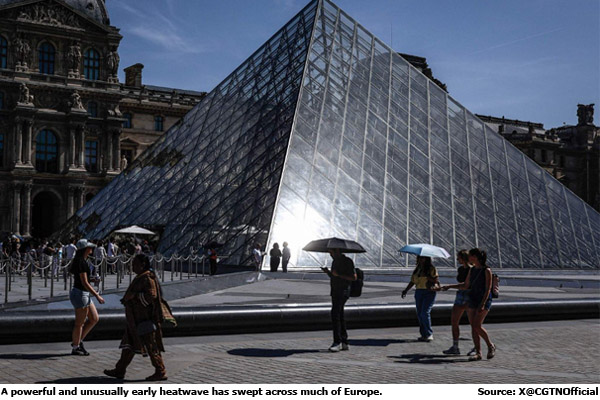
Europe Heatwave: This May, a British tourist was spotted enjoying a Piña Colada on the streets of Europe as early as 11 a.m. “It’s very hot; it’s extremely hot,” he told France24. This remark offers a glimpse into the unusual weather currently gripping the whole of Europe, including Britain.
In fact, the continent is currently in the grip of a powerful ‘heat dome.’ This vast mass of hot air, trapped beneath a high-pressure system, is pushing temperatures well above normal levels, leading to scorching heat and increased health risks across several countries.
On Tuesday, millions of people across Europe were facing extraordinary temperatures. In a desperate bid to find relief from the heat, 40 people drowned in France last week while swimming or visiting bodies of water.
Meanwhile, the UK’s Met Office has issued a ‘Red Extreme Heat Warning’ for Wednesday and Thursday. Temperatures are forecast to reach 39°C or higher, potentially breaking the record for the hottest June day on record. The weather agency has warned that the mercury could climb even higher in some areas.
Forecasters in France predict that temperatures in Paris could hit 40°C this week—an unprecedented high for June. Météo-France stated that “exceptionally high temperatures” are expected both day and night.
Spain’s national weather service, Aemet, also issued a red alert on Tuesday for temperatures reaching 44°C (111°F) in southern Andalusia. Additionally, warnings were issued for temperatures hitting 40°C (104°F) in the Cantabria and Basque Country regions—areas along the North Atlantic coast that typically experience moderate temperatures. According to numerous experts and reports, the cause of this unseasonably hot weather is a so-called “heat dome.”
A New York Times report states, “Heat domes form around the world, and the heat dome currently over Europe has sustained near-record temperatures for several days across Britain, Spain, and France.”
What is a heat dome?
In a video, the UNDRR explained that a heat dome forms when a massive bubble of high-pressure air settles over a specific region.
It noted, “It traps heat much like the lid on a pot.”
According to the agency, this occurs when the jet stream—a fast-moving current of air that typically drives weather systems forward—slows down or stalls.
When this happens, extreme weather events such as heatwaves, torrential rains, or wildfires can remain trapped in one location for days or even weeks.
‘Heat dome’ caused by an Omega block
An Omega block and a heat dome are related but distinct phenomena. Simply put, the Omega block is the cause, and the ‘heat dome’ is the result.
Citing a weather analyst, Reuters reported that a so-called “Omega block” weather pattern is driving an intense, slow-moving heatwave across Europe, forcing authorities throughout the continent to issue heat warnings.
The report describes this pattern as an “Omega block,” characterized by a trapped dome of warm air at the center flanked by masses of cooler air on either side.
It is called an Omega block because it resembles the Greek letter Omega; the warm air bulge sits in the middle with cooler air on the sides, causing temperatures to rise steadily day after day. The Royal Meteorological Society (RMS) explains that the position and strength of the jet stream can create ‘blocking’ conditions, such as an ‘Omega block.’ In this scenario, a high-pressure area becomes trapped between two low-pressure systems, forming a shape resembling the Greek letter Ω (Omega).
Jet streams are fast-moving winds high above the Earth’s surface that help form and drive the movement of low-pressure systems. They typically flow from west to east, “but sometimes they can stall or get stuck—often when the jet stream weakens and develops kinks or meanders.”
High-pressure systems prevent weather fronts from advancing; consequently, these fronts either skirt the edges of the high-pressure zone or stall in place.
The Royal Meteorological Society (RMS) states, “Your location relative to the Omega block determines the weather you experience. Conditions under high pressure are generally dry and stable, whereas low-pressure areas bring rain and strong winds. Such weather blocks can persist for days, weeks, or even months, as happened during the summer of 1976.”
What exactly is the ‘heat dome’ scorching Europe?
The Royal Meteorological Society (RMS) notes that the problem with a stubborn high-pressure zone is that the air trapped beneath it—already warm—heats up further, creating a ‘heat dome.’
They explain, “Warm air rises into the atmosphere, but the high-pressure system acts like a lid, forcing the air to sink or compress. As the air descends, the increasing pressure causes it to warm up, intensifying the heat. The ground also heats up and loses moisture, making it easier for temperatures to rise even higher.”
He adds, “Unless the pressure pattern shifts, the high-pressure system will continue to exacerbate heat conditions, increasing the risk of wildfires, droughts, and heat-related health issues.”
Experts state that human-induced climate change is increasing the likelihood of such patterns.
Why is Europe getting so hot?
On June 17, the UK Met Office stated that the developing heatwave is being driven by a strong area of high pressure building over continental Europe.
They explained, “This high-pressure system promotes large-scale sinking of air, which inhibits cloud formation, allows for prolonged sunshine, and causes temperatures to rise due to compression-induced heating.”
The UK is caught between two air masses
While Europe is heating up, the UK will experience a more complex and shifting pattern. The UK Met Office noted that low pressure in the northwest will continue to bring clouds, rain, and cooler air.
They added, “At the same time, a plume of hot air from the continent will attempt to push northward. This will create a sharp contrast over the UK, where the boundary between warm and cool air masses—known as a ‘baroclinic zone’—will form over or near the country.”
The impact?
Weather fronts will form along this boundary and move slowly, bringing rain, particularly to northern and western regions. The UK Met Office further stated, “This will result in a ‘wavy’ front, with bands of rain lingering or oscillating over the same area for several days.”
(With agency inputs)