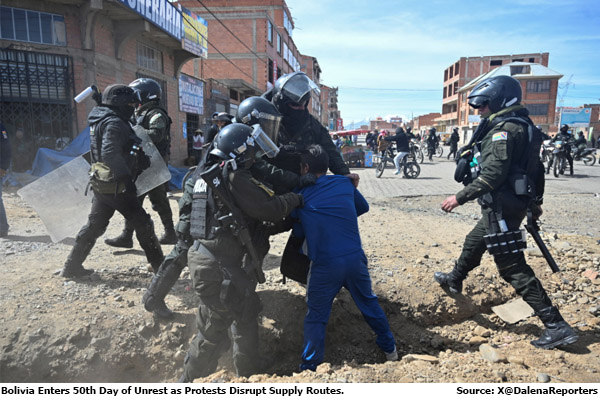
Bolivia Unrest: According to an AP report, Bolivian President Rodrigo Paz declared a state of emergency in the country on Saturday. This decision grants the military additional powers to clear road blockades that have severely disrupted fuel and food supplies in several major cities, including the capital.
Five weeks of protests escalate the crisis
Massive protests have been ongoing for the past five weeks against the government’s austerity measures, which include cuts to fuel subsidies and other economic reforms. Demonstrators are also demanding the President’s resignation. Violent clashes have erupted between anti-riot police and protesters, with some demonstrators allegedly using dynamite. According to officials, 365 people have been arrested so far, and 37 have been injured.
Medical services disrupted; several deaths reported
According to Bolivia’s ombudsman’s office and human rights organizations, at least 17 people have died due to a lack of timely medical care caused by the unrest and transportation disruptions.
Road blockades cause fuel and food crisis in capital La Paz
According to the AP report, the government states that the capital, La Paz, has been virtually cut off due to barricades erected on major highways. This has led to severe shortages of fuel and food, disrupted transportation, and prevented many patients from reaching hospitals on time. Officials report that at least seven people have died so far due to the inability to access medical care.
President Paz declares 90-day state of emergency
Addressing the nation on television, the President said, “This is not an emergency to restrict people’s lives; it is an emergency to restore people’s freedom.” As the protests dragged on, many businesses shut down, supermarket shelves emptied, and hospitals reported shortages of oxygen supplies. Amidst the deteriorating situation, some segments of society urged President Paz to use force to restore order.
Protests continue despite agreement with labor union
On Friday night, Paz reached an agreement with a labor union whose leaders called for the lifting of road blockades. However, other groups of protesters have continued to demand his resignation and have refused to engage in dialogue.
Government prioritizes ensuring fuel supply
Paz stated that the state of emergency aims to ensure fuel supplies, which have dwindled significantly as tanker trucks remain stranded due to road blockades.
Military authorized to clear roads and restore order
The decree prohibits the blocking of streets, roads, and highways in a manner that disrupts transport and supplies, and orders the armed forces to assist the police in “restoring order, opening roads, and ensuring public safety.”
According to an AP report, the decree specifies that the state of emergency does not curtail due process rights or constitutional guarantees, and people may continue their daily activities. The government stated that the emergency measure would remain in effect for 90 days but could be lifted earlier if “violence and threats against the public cease.”
Austerity policies and subsidy cuts fuel inflation
Paz assumed office in November, ending nearly 20 years of continuous rule by Bolivia’s ‘Movement Toward Socialism’ (MAS) party—a period during which the country had witnessed its worst economic crisis in a generation. Paz, who won by defeating more conservative candidates, pledged to resolve chronic fuel shortages and replenish the central bank’s nearly depleted coffers, while also promising to maintain the social welfare programs that formed the foundation of the MAS party’s popularity.
Key proposals stalled in Congress despite economic reforms
However, his austerity measures—specifically the decision to eliminate long-standing fuel subsidies—exacerbated inflation. While his government succeeded in alleviating fuel shortages, the supply of poor-quality gasoline caused thousands of vehicles to break down. Reforms aimed at boosting foreign investment and accelerating economic growth remain stalled in Congress.
Indigenous and rural groups spearheading the protests
Indigenous communities from highland regions and rural labor groups—who had long supported the MAS but helped bring Paz to power last year—are leading these protests. They allege that his government has ignored their needs since taking office.
Mounting political pressure from both the Right and the Left
He faces escalating pressure from two sides: Bolivia’s hard-right faction (which dominates Congress) and the long-ruling leftist faction. Former President Evo Morales has backed the protests and demanded new elections. He remains in hiding in a tropical coca-growing region, evading an arrest warrant related to statutory rape charges.
Trump Administration Steps Up Support; Marco Rubio Offers Assistance
The Trump administration has backed Paz, who had improved relations with the US following years of hostility toward Western nations in Bolivia during the Morales era.
Bolivia Faces Major Challenges Amid Economic Crisis and Political Turmoil
US Secretary of State Marco Rubio called Paz last week to convey that Washington is “increasing emergency aid and logistics operation support” to help address shortages caused by the blockades.
US Secretary of Defense Pete Hegseth described the protests as an “attempt to topple a legitimate government” and issued a stern warning to those who, in his words, “are profiting from death and destruction in our region.”
(With agency inputs)