Malviya Nagar Tragedy: A grave disregard for safety standards at a B&B in South Delhi’s Malviya Nagar turned into a horrific tragedy on Wednesday morning. Preliminary investigations have revealed that the building possessed neither a fire safety certificate nor adequate windows or emergency exit provisions. The premises had only one functional gate, while essential fire-fighting equipment was also conspicuously absent. Furthermore, the building allegedly featured unauthorized construction. The fire, sparked by these safety lapses, claimed the lives of at least 21 people, while many others sustained injuries.
The disregard for fire safety regulations, unauthorized operations, and an alleged insatiable greed for higher profits gave birth to this horrific tragedy in South Delhi. The cost of compromising on safety measures was paid with the lives of 21 people. This incident is not merely an accident, but a stark illustration of negligence and greed.
The investigation also revealed that, despite permission for only 6 rooms, 25 rooms were operating illegally—a clear indication of potential regulatory violations. Moreover, obtaining a Fire NOC (No Objection Certificate) is a mandatory prerequisite for conducting any commercial activity—a document that the owner of this B&B did not possess at all.
This is not the first instance of a fire-related tragedy. Such disasters have surfaced periodically across various parts of the country, including the capital, invariably concealing a backstory of disregarded safety standards, administrative negligence, and lax enforcement of regulations. Following every major tragedy, inquiries are ordered, assurances of action against those responsible are issued, and discussions regarding accountability persist for a brief period. However, as time passes, the matter is inevitably shelved, and the system reverts to its old, complacent ways.
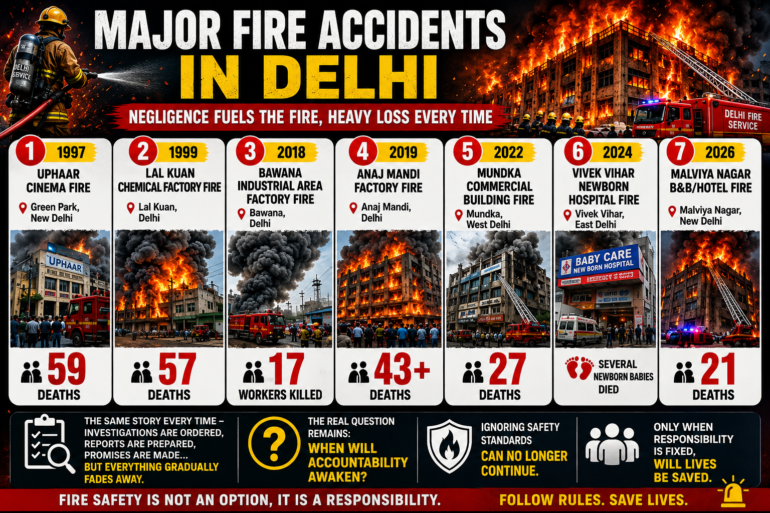
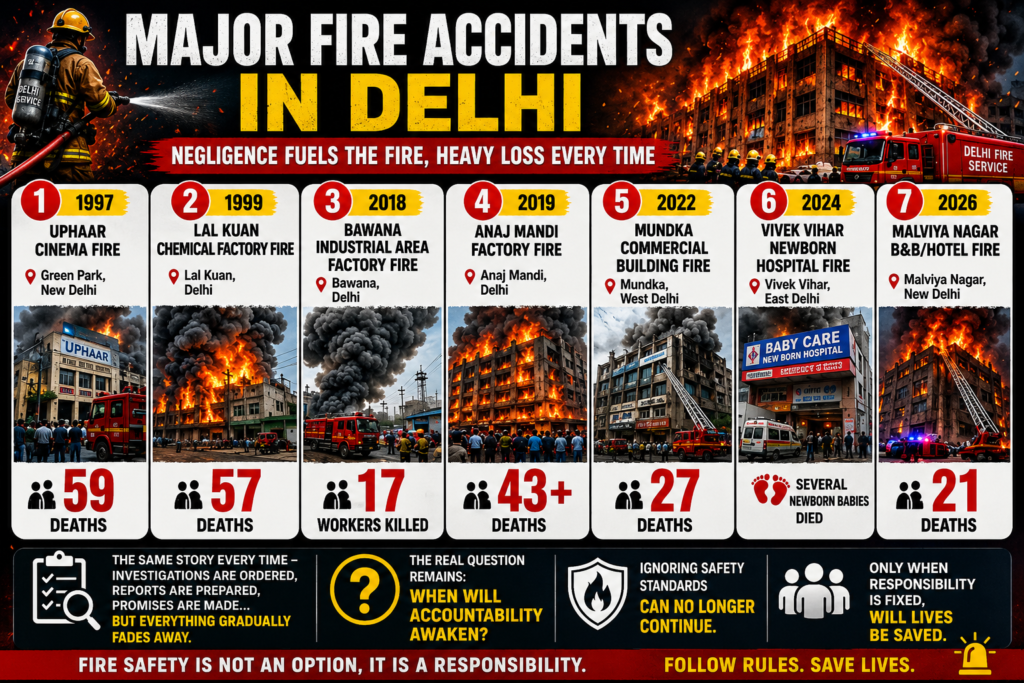
From Uphaar to Malviya Nagar: Delhi’s Major Fire Tragedies
Uphaar Cinema Fire Tragedy (1997)
One of the most devastating fire incidents in Delhi’s history. During a film screening, a fire broke out in a transformer, causing thick smoke to engulf the area; exit routes were blocked, and chaos ensued. 59 people lost their lives, and more than 100 others were injured. The subsequent investigation revealed numerous violations of fire safety regulations, including blocked exit doors and inadequate emergency preparedness.
Lal Kuan Factory Fire (1999)
A massive fire that erupted in a chemical factory located in Old Delhi spread rapidly due to the presence of highly flammable materials. In a matter of moments, the fire engulfed the entire premises, leaving the workers inside no opportunity to react or escape. This tragic incident claimed the lives of 57 people, while many others sustained severe injuries.
Bawana Industrial Area Fire (2018)
A massive fire broke out in a factory situated in the Bawana Industrial Area of North-West Delhi. Investigations revealed that the factory was allegedly manufacturing firecrackers without the necessary permits or adherence to safety standards. The fire spread with such speed that many laborers did not get a chance to escape. This tragic accident resulted in the deaths of 17 laborers, while several others suffered burns. The incident raised serious questions regarding the enforcement of safety regulations and oversight mechanisms within industrial units.
Anaj Mandi Factory Fire (2019)
A massive fire that broke out in the Anaj Mandi area of Old Delhi shook the national capital to its core. Due to narrow lanes and a lack of safety standards, the fire spread rapidly throughout the entire building. Reports indicated that the building lacked adequate fire safety equipment, emergency exits, and ventilation systems. At the time of the incident, many laborers were sleeping inside, preventing them from escaping in time. This tragic event claimed the lives of over 43 people and left many others injured. The accident underscored the critical need for strict adherence to safety regulations within commercial establishments.
Mundka Commercial Building Fire (2022)
The fire spread so rapidly that many people inside the building did not get a chance to escape. Preliminary investigations raised serious questions regarding safety standards and emergency exit arrangements. At least 27 people lost their lives in this tragic incident, while many others sustained injuries. The event once again underscored the necessity of strictly adhering to fire safety regulations in commercial buildings.
Vivek Vihar Hospital Fire (2024)
A massive fire that broke out at a neonatal hospital in Vivek Vihar, East Delhi, exposed the glaring inadequacies in safety protocols. Chaos ensued within the hospital following the outbreak of the fire, and several newborns were engulfed by the flames. This tragic incident claimed the lives of several innocent infants, while relief and rescue operations were launched to evacuate others to safer locations. In the aftermath of the event, serious questions were raised regarding the hospital’s fire safety infrastructure, licensing, and emergency response system—questions that highlighted the critical need for strict compliance with safety standards in healthcare institutions.
Who Is Responsible for These Tragedies?
Such recurring and horrific accidents raise a fundamental question: Who, ultimately, bears the responsibility? Are the building owners and operators solely to blame, or should accountability also be fixed upon the government agencies under whose supervision these establishments continue to operate for years while flouting regulations? If safety standards were not being adhered to within a building, it is only natural for questions to be raised regarding the oversight mechanisms of the concerned departments.
Merely arresting the owners or ordering an inquiry after an accident is not sufficient. What is required is the establishment of a comprehensive chain of accountability to prevent such incidents. In the specific area where such an accident occurs, the roles and inspection protocols of the concerned police force, municipal body, and fire department must also be subjected to an impartial investigation. If any official is found culpable during the inquiry, the strictest possible action must be taken against them.
Until accountability is firmly established for those who disregard safety standards and those who fail in their oversight duties, such tragedies will continue to recur, and ordinary citizens will have to pay the ultimate price—with their lives.
If Delhi is not safe, then what of the rest of the country?
The recurring incidents of this nature in the national capital serve as a clear indication that the urban safety infrastructure is in dire need of comprehensive reform. If this is the state of affairs in the national capital, it only heightens concerns regarding the status of safety standards in other states across the country.