
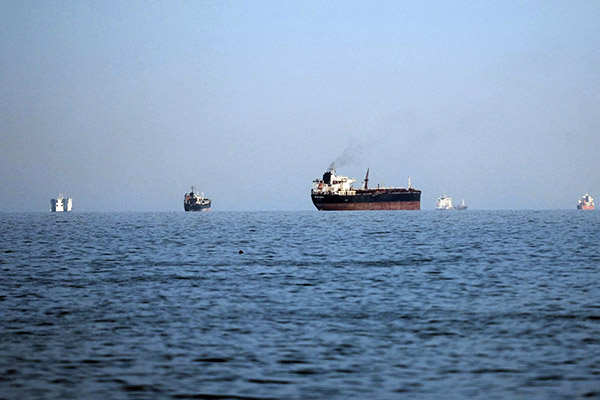
Iran Missile Attack: Roughly two weeks after the US conducted military action against Iran in response to an attack on a commercial vessel near the Strait of Hormuz, Iran has once again escalated tensions in the region. According to US officials, Tehran’s forces fired two missiles at commercial ships passing through the Strait of Hormuz.
According to an Axios report, two US officials stated that the incident occurred on Monday night. The report also mentions that the US is considering targeting Iranian military sites in response to this attack, although no official announcement has been made regarding this yet.
Missile attack on commercial ships
According to the report, this alleged attack was carried out by Iran’s Islamic Revolutionary Guard Corps (IRGC). The incident has heightened security concerns in the region and raised questions about the future of a recently signed 14-point Memorandum of Understanding (MoU). This agreement, signed less than three weeks ago, included an assurance from Iran to halt attacks on commercial vessels in the Strait of Hormuz.
The Strait of Hormuz, one of the world’s most critical maritime trade routes, has long been a focal point of tension between the US and Iran. Any military action in this area could impact global oil supplies, shipping, and international trade.
According to a Reuters report, the United Kingdom Maritime Trade Operations (UKMTO) agency stated on Tuesday morning that a ship was struck on its port side by an unidentified object (projectile) while heading south, approximately 8 nautical miles (15 km) east of Limah, Oman, causing a fire. The report added that there were no reports of casualties or environmental impact. A US official told Axios that another commercial vessel had been attacked by an Iranian missile.
Over the weekend, Reuters cited a maritime radio recording from the IRGC in which it warned commercial vessels, stating, “Our missiles and drones are ready to attack you.”
Which ships were targeted?
According to The Wall Street Journal, one of the ships attacked was the ‘Al Rekayyat’. It is a liquefied natural gas (LNG) tanker owned and managed by Nakilat, the shipping arm of Qatar’s LNG industry.
The report further stated that the vessel was in the Gulf of Oman, at the mouth of the Strait of Hormuz, when the attack occurred.
Earlier on Monday, US President Donald Trump stated that the US would either reach an agreement with the Islamic Republic or “get the job done” (implying military action). He reiterated his threat of military action as Tehran adopted a defiant stance following the funeral of former Supreme Leader Ayatollah Ali Khamenei.
He added, “Either we make a deal, or we get the job done. Okay? And getting the job done wouldn’t be hard. I would much prefer to make a deal, because I don’t want to affect 91 million people.”
Following Trump’s warning, Mohammad Baqer Zolqadr, Secretary of Iran’s Supreme National Security Council, dismissed the US President’s threat as “delusional.” Zolqadr said, “We can bring down their bridges and cut off their energy supplies in an hour… They have no money left. We haven’t given them any money,” adding, “The Iranian people are unfamiliar with the language of threats. So, speak to the Iranian people with respect; otherwise, we will respond in a different language.” This development comes roughly a week after indirect talks between Washington and Tehran concluded in Doha, the capital of Qatar.
US-Iran Indirect Talks
The aim of these indirect talks—which ended without any public signs of a breakthrough toward lasting peace, despite a 60-day ceasefire—was to create space for diplomacy following attacks on Iran by the US and Israel in late February.
Praising the indirect talks between Washington and Tehran, the US President remarked that the two sides had held very productive meetings. He added, “They had very good meetings, and we shall see. As you know, we launched heavy attacks on them over three nights, but our relations are very good now; so, I call this the process of denuclearization, and it is all happening.” However, he did not clarify whether any breakthrough had been achieved.
It remains to be seen, however, whether Washington will respond to Tehran’s attacks in the Strait of Hormuz.
(With agency inputs)